
If you own or plan to own a Cadillac Lyriq, you’ve probably asked yourself a very practical question:
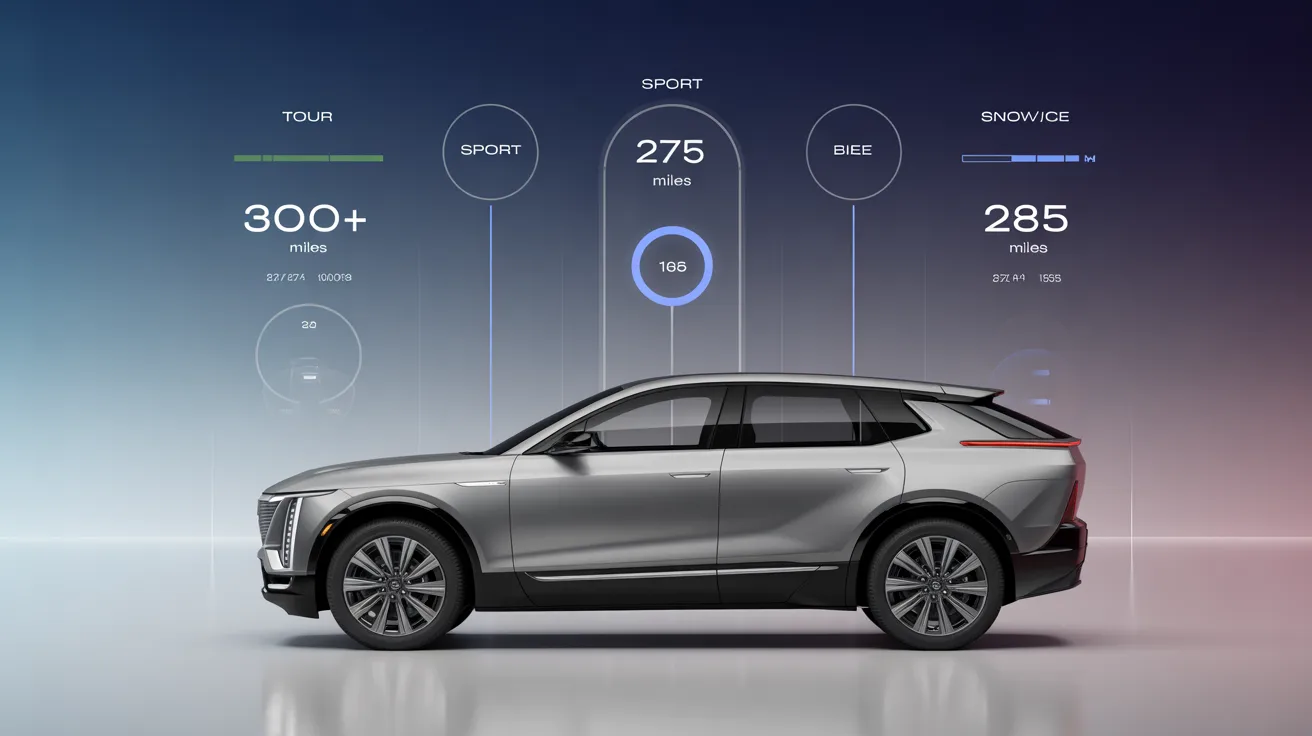
Do the driving modes in Cadillac Lyriq offer different ranges or battery usages, or does it just feel that way?
It’s a smart question. Driving modes promise comfort, sportiness, or extra traction. But when range anxiety kicks in, promises don’t matter. Real-world data does.
This guide breaks everything down in plain English, using real-world EV behavior, not marketing fluff. You’ll learn what actually changes, what doesn’t, and why your driving behavior matters more than the mode itself.
The Short, Honest Answer (What Changes — and What Doesn’t)
Let’s clear the air right away.
Driving Modes in the Cadillac Lyriq do NOT directly change:
- Battery capacity
- Usable capacity
- Ultium-based battery pack chemistry
- EPA range estimates
However, they DO indirectly affect:
- Energy consumption
- Power draw
- Throttle response
- Torque delivery
- Driver behavior, which is the biggest factor
👉 In other words:
Driving modes don’t drain the battery by themselves. How you drive in those modes does.
How the Cadillac Lyriq Uses Energy
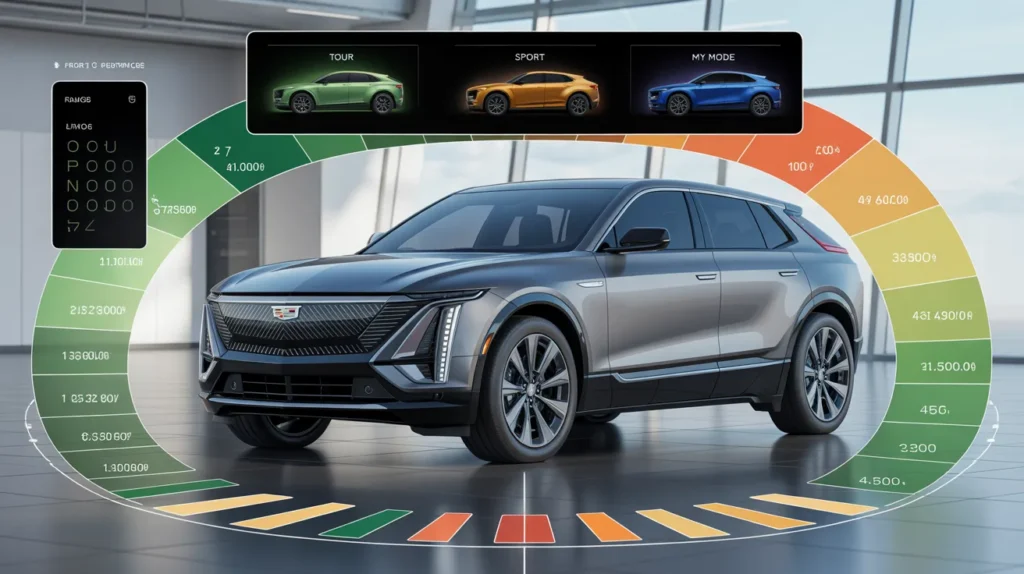
The Cadillac Lyriq is built on GM’s advanced Ultium Battery Platform, designed for flexibility, efficiency, and longevity.
Key Battery Facts
| Specification | Cadillac Lyriq |
| Battery type | Ultium-based battery pack |
| Total battery capacity | 100 kWh |
| Usable capacity | ~95 kWh |
| Platform | Ultium Battery Platform by GM (General Motors) |
| Architecture | 400V |
| Cooling | Active liquid thermal management |
The Lyriq’s electric motors, inverter, and software constantly decide how much energy to pull from the battery based on:
- Accelerator input
- Speed
- Terrain
- Temperature
- Regenerative braking availability
Driving modes don’t rewrite physics. They rewrite how the car responds to you.
What Driving Modes Are Really Designed For
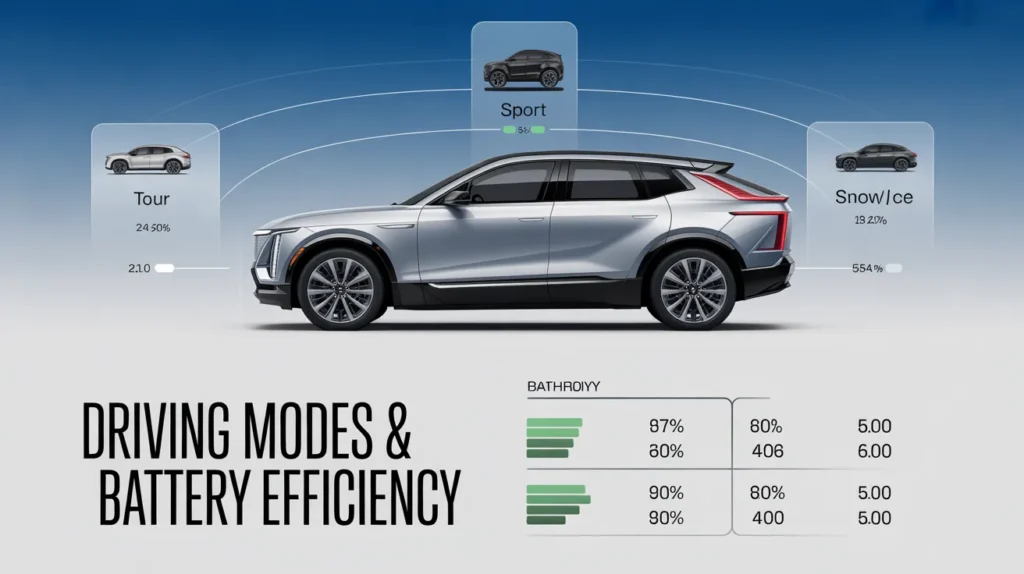
Despite popular belief, Driving Modes in an Electric Vehicle (EV) are not efficiency presets.
They exist to manage:
- Throttle mapping
- Accelerator sensitivity
- Steering feel
- Stability systems
- Traction control
- Regen intensity
Think of driving modes as behavior translators, not battery governors.
Cadillac Lyriq Driving Modes Explained (What Actually Changes)
Tour Mode (Default Everyday Mode)
Tour Mode—sometimes called Touring Mode—is the Lyriq’s baseline.
What changes in Tour Mode:
- Smooth throttle response
- Balanced torque delivery
- Predictable steering feel
- Moderate regenerative braking
- Stability systems prioritize comfort
Range impact:
Tour Mode usually delivers the best real-world range because it discourages aggressive inputs.
Tour Mode doesn’t save energy directly—it keeps you from wasting it.
Sport Mode (Performance-Focused)
Sport Mode sharpens everything.
What changes:
- Aggressive accelerator sensitivity
- Faster torque availability
- Heavier steering feel
- Increased power spikes during acceleration
Battery usage reality:
- Higher kWh per mile if driven aggressively
- Same efficiency at steady highway speeds
- Increased energy consumption during rapid acceleration
Sport Mode feels faster because it gives you more power sooner—not because it uses more power constantly.
Snow / Ice Mode (Traction Over Everything)
Snow / Ice Mode is about control, not efficiency.
What changes:
- Reduced torque output
- Slower throttle ramp-up
- Stronger traction control
- Stability systems intervene earlier
Does Snow Mode reduce range?
Not automatically.
Range drops mainly because:
- Cold weather reduces battery efficiency
- Cabin heating increases power draw
- Regenerative braking becomes limited
My Mode (Custom Driving Profile)
My Mode lets you mix settings.
You can customize:
- Throttle response
- Steering weight
- Regen feel
- Suspension behavior (if equipped)
Efficiency potential:
High—if you tune it properly.
Risk:
Many drivers accidentally create a Sport-like profile and blame the mode for range loss.
Tour Mode vs Sport Mode: Real Differences That Matter
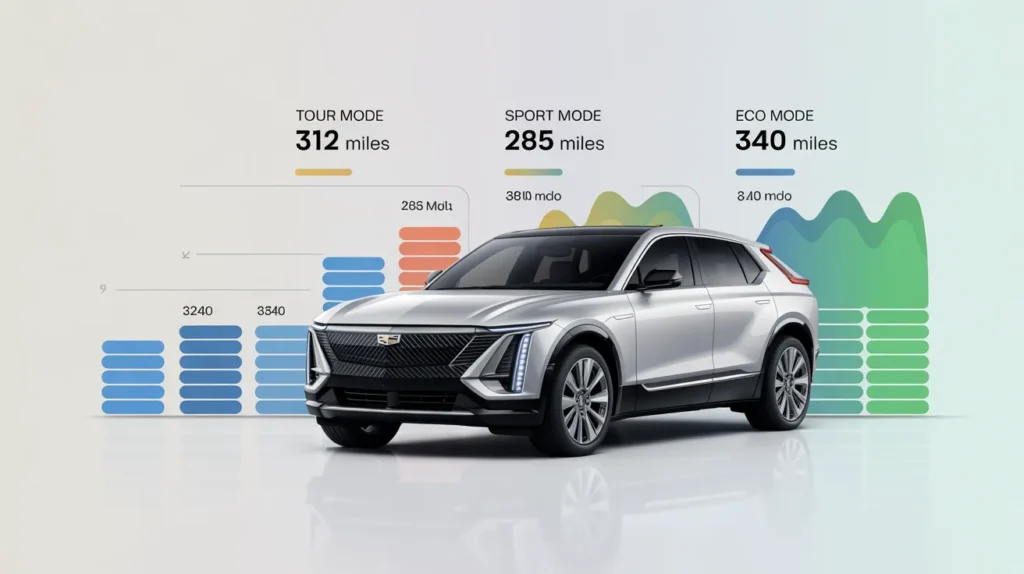
| Feature | Tour Mode | Sport Mode |
| Throttle mapping | Gradual | Aggressive |
| Power draw | Smooth | Spiky |
| Driver behavior | Calm | Excited |
| Energy consumption | Lower | Higher (if pushed) |
| Best use case | Daily commuting | Performance driving |
Key takeaway:
Sport Mode doesn’t reduce range on its own. Your right foot does.
Why Driving Modes Affect Range Indirectly
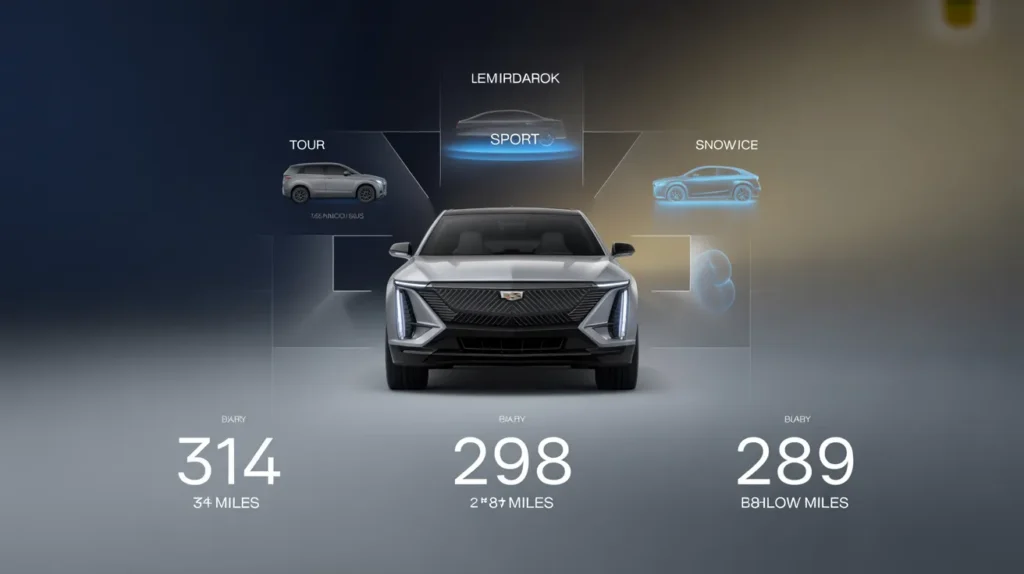
Driving modes influence how easy it is to waste energy.
- Aggressive throttle → Acceleration spikes
- Acceleration spikes → Higher power draw
- Power spikes → Higher kWh per mile
The battery doesn’t know which mode you’re in.
It only knows how much power you demand.
Regenerative Braking: More Important Than Driving Mode
How Regenerative Braking Works
When you slow down, the Lyriq’s electric motors reverse function and act as generators.
This allows:
- Deceleration energy recovery
- Reduced brake wear
- Improved city driving efficiency
One-Pedal Driving
One-pedal driving lets you accelerate and decelerate with a single pedal.
Benefits:
- Higher energy recovery
- Fewer friction brake events
- Better stop-and-go traffic efficiency
Downside:
Abrupt lifts can reduce smoothness if not mastered.
Regen on Demand
Regen on Demand gives manual control over regenerative braking.
Best used:
- In city traffic
- On downhill slopes
- During controlled slowdowns
One-Pedal Driving On vs Off: Does Range Change?
| Scenario | One-Pedal ON | One-Pedal OFF |
| City driving | Better efficiency | Lower efficiency |
| Highway cruising | Similar | Similar |
| Hilly terrain | Advantage | Less recovery |
Bottom line:
One-pedal driving improves Real-World Range mostly in urban environments.
Real-World Range of the Cadillac Lyriq (Not EPA Fantasy)
EPA Range Estimates
| Configuration | EPA Estimated Range |
| RWD (Rear-Wheel Drive) | 312 miles |
| AWD (All-Wheel Drive) | 307 miles |
Real-World Range Expectations
| Driving Type | Typical Miles per Charge |
| City-heavy | 300–320 miles |
| Mixed driving | 270–290 miles |
| Highway-heavy | 240–260 miles |
Why AWD Lyriq Has Lower Range Than RWD
Dual-motor AWD adds:
- Extra weight
- Additional energy losses
- More drivetrain friction
Even when the second motor isn’t active, it creates resistance.
Result:
AWD trades efficiency for traction and performance.
Cold Weather Performance (−15°C to −20°C)
In extreme cold, EVs face real challenges.
What happens:
- Slower battery chemistry
- Reduced regenerative braking
- Increased cabin heating demand
- Higher rolling resistance
Expected winter range loss:
- 20–35% depending on conditions
AWD performs better in traction but still loses range.
Switching Driving Modes While Driving: Is It Safe?
Yes. Completely safe.
Driving mode switching:
- Happens via software behavior
- Doesn’t interrupt power delivery
- Doesn’t harm battery health
Avoid switching during:
- Heavy acceleration
- Complex maneuvers
What Affects Range More Than Driving Modes
Speed and Acceleration Patterns
- Aerodynamic drag rises exponentially
- Driving at 80 mph vs 65 mph can reduce range by 20%
City vs Highway Driving
- EVs are more efficient in cities
- Highways limit regenerative braking
Weather and Temperature
- Cold reduces battery efficiency
- Heat increases HVAC usage
Terrain, Tires, and Load
- Hills drain energy faster
- Low tire pressure increases resistance
- Extra cargo adds weight
Choosing the Right Mode for Your Situation
Daily Commuting
- Tour Mode
- One-pedal driving ON
Long Highway Trips
- Tour Mode
- Steady speed
- Minimal acceleration spikes
Winter Driving
- Snow / Ice Mode
- Expect reduced range
Short Performance Driving
- Sport Mode
- Enjoy it—just don’t expect maximum range
Practical Tips to Maximize Range Without Obsessing
- Precondition while plugged in
- Maintain steady speeds
- Use seat heaters instead of blasting HVAC
- Keep tires properly inflated
- Don’t overthink driving modes
A Simple At-Home Test to Measure Mode Impact
- Pick a familiar route
- Drive once in Tour Mode
- Repeat in Sport Mode
- Keep speed and traffic similar
- Compare kWh per mile
You’ll see behavior matters more than the mode.
Do Driving Modes Matter More Over Time?
No.
Driving modes:
- Don’t degrade battery health
- Don’t alter charging practices
- Don’t change usable capacity
Long-term efficiency depends on:
- Driving style
- Charging habits
- Climate exposure
Final Verdict: Do Driving Modes in Cadillac Lyriq Offer Different Ranges or Battery Usages?
Not directly.
Driving modes influence how you drive, not how the battery behaves.
Driver behavior → energy consumption → real-world range
Master that chain, and the Lyriq rewards you with impressive efficiency.
FAQs
Which driving mode gives the best range?
Tour Mode, paired with smooth driving.
Does Sport Mode damage the battery?
No. It only increases energy use if driven aggressively.
Can My Mode improve efficiency?
Yes, if tuned with gentle throttle mapping.
Does Snow / Ice Mode always reduce range?
No. Cold weather does. The mode improves control.
What matters more: driving mode or driving style?
Driving style—by a wide margin.

